

If you’ve used Krisp before, you already know how much cleaner audio can change the quality of a call. But in 2026, the market for Krisp alternatives is way bigger – and the differences between tools go far beyond “noise cancellation on/off.” Some apps are system-wide and work everywhere, others are built directly into meeting platforms, and a few focus on studio-grade voice processing (with trade-offs like CPU load or added latency). On top of that, privacy and compliance matter more than ever, especially if calls include customer data or internal planning. In this guide, we’ll break down the best competitors by real-world performance, compatibility, and value, so you can pick the right tool for how you actually work.
Here’s the summary of the top Krisp alternatives:
- FuseBase: Best overall for client-facing teams. Bot-free recorder, internal vs external split, branded client portals, AI agents that create tasks and flag scope creep.
- Utterly: Mac-only, on-device noise cancellation. Privacy-first, battery-efficient, excels at filtering static; audio-only focus.
- Granola: Solo speed. Local capture, clean notes, templates. Personal productivity over enterprise depth.
- Jamie: Multilingual, privacy-first, bot-free. Fast summaries across online and in-person.
- Bluedot: Chrome-first, bot-free automation. 100+ languages, AI follow-ups, CRM ties; strongest in Google ecosystems.
- Tactiq: Real-time transcription to tasks. Live captions, agendas, email drafts; weaker with unclear audio/accents.
- Otter: Collaboration and accessibility. Live captions, shared notes, and mobile.
- Read.ai: Live insights and coaching. Sentiment, engagement metrics, Speaker Coach, cross-platform search.
- Supernormal: Bot-free notes + task sync. Templates, Ask Norma Q&A, pushes to Asana/ClickUp/Linear/Trello.
What is Krisp?
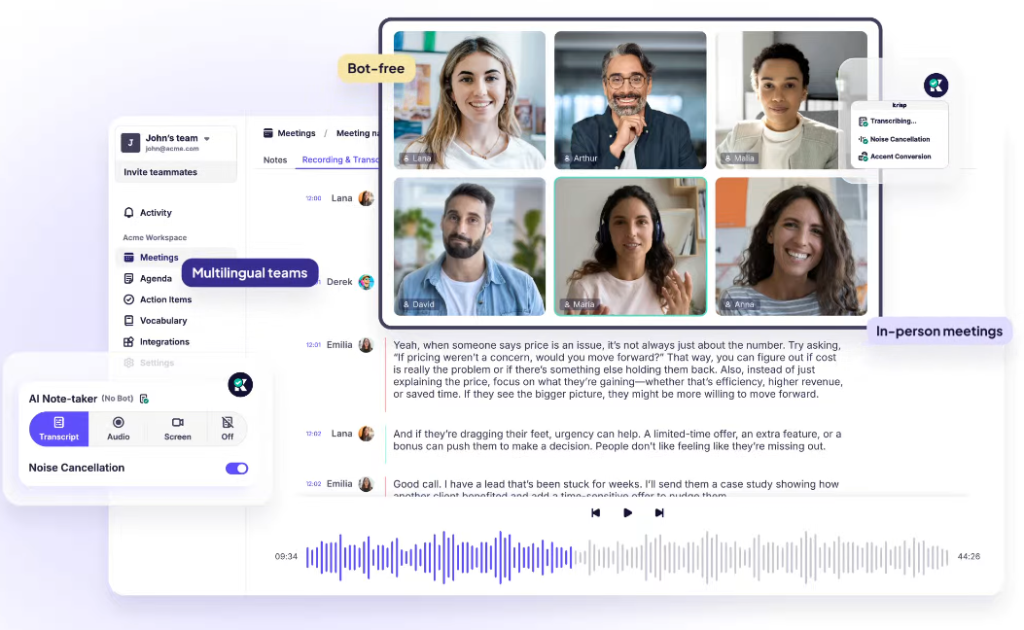
Krisp began as an on‑device noise canceller and has evolved into an AI meeting assistant. Its core strength is still audio: removing background noise and unwanted voices, plus accent smoothing to make speakers clearer. On top, Krisp now auto‑transcribes meetings, generates notes and summaries, and can draft follow‑up emails. It plugs into the tools teams already use – Meet, Microsoft Teams, and Zoom – and runs much of the processing locally, which users value for performance and privacy.
Krisp is a strong pick if your priority is consistently clean, intelligible calls in noisy environments, and you want a simple, low‑friction add‑on to existing workflows. If you need more than clean audio, it’s time to explore Krisp alternatives.
What to Look For in Krisp Alternatives?
Noise cancellation is table stakes in 2026. The shift is from signal processing to semantics – from cleaner audio to cleaner outcomes. Pick tools that turn every call into usable insight, client-safe output, and automated follow-through.
- Smart partition: You still need clear audio, but the real win is blocking informational noise. Look for automatic dual outputs like a client-ready recap that hides sensitive pricing and margins, and a raw internal version for the team.
- Clean data: Transcripts should flow straight into work. The right alternative filters action items, creates tasks, assigns owners, and sets due dates in tools like Asana or ClickUp.
- Bot-free experience: Silent meeting guests annoy people. Favor solutions that process locally and do not join as a visible bot. Next step to evaluate is private, on-device or tenant-local AI that generates summaries and insights without appearing in the participant list.
- Scope creep detection: Watch for AI that flags out-of-scope asks and quiet commitments. It should surface risks to margin and timeline in real time, not after the quarter. This protects revenue and reduces surprise costs that slip past busy reps.
- Privacy and control: Prioritize local or regional processing, consent handling, PII redaction, role-based access, and clear retention policies. If you record clients, compliance is not optional.
- Workflow fit: Meet, Teams, and Zoom are a given. Also check CRM, ticketing, and docs integrations so summaries, next steps, and risks show up where teams actually work. Setup should take minutes, not a quarter.
- Outcome proof: Demand measurable impact. Faster time to first action, fewer missed follow ups, cleaner client recaps, and earlier risk flags. If an alternative cannot show numbers, it is just another audio filter.
Top Krisp alternatives in 2026
1. FuseBase
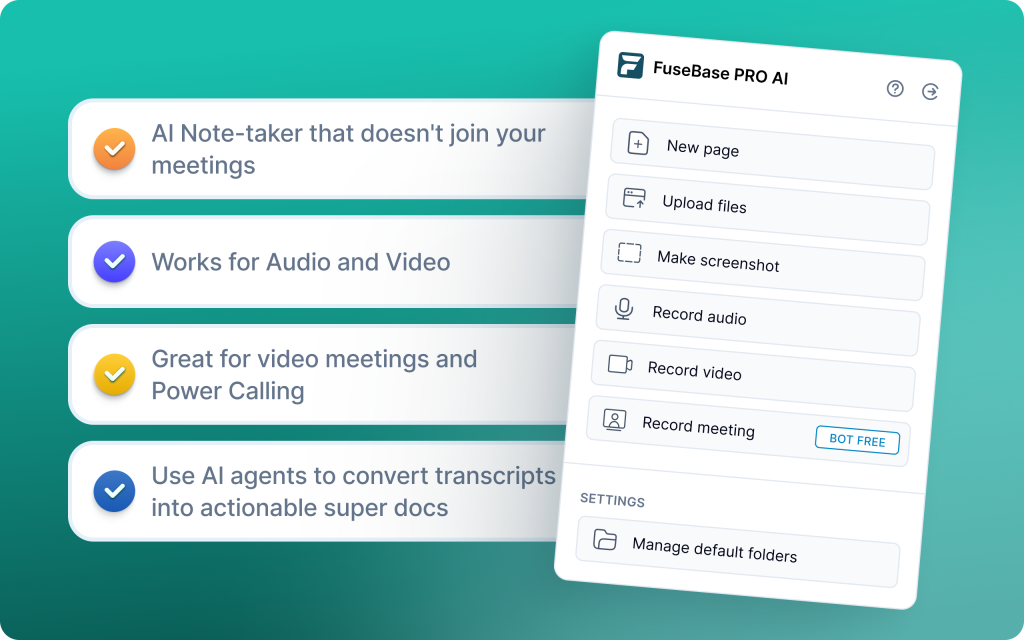
FuseBase matches Krisp’s privacy-first approach with a bot-free recorder and a lightweight browser extension that captures Zoom, Teams, and Meet without adding silent guests. Then it goes further. Every call becomes a shareable mini-room with recap, files, and next steps – not just a naked transcript link. FuseBase uses AI Agents to separate internal risks like scope creep, margins, and coaching notes from the safe-to-share client recap, automatically producing two outputs by default.
For professional services, agencies, and client success teams managing high-value accounts, FuseBase replaces a raw text summary with a polished portal that clients actually use. You get privacy-first recording, internal vs external partitioning baked in, and automated next steps that reduce glue work. If your 2026 requirement is outcomes, FuseBase is the alternative that upgrades every meeting into a live, branded workspace that drives delivery and retention.
2. Utterly
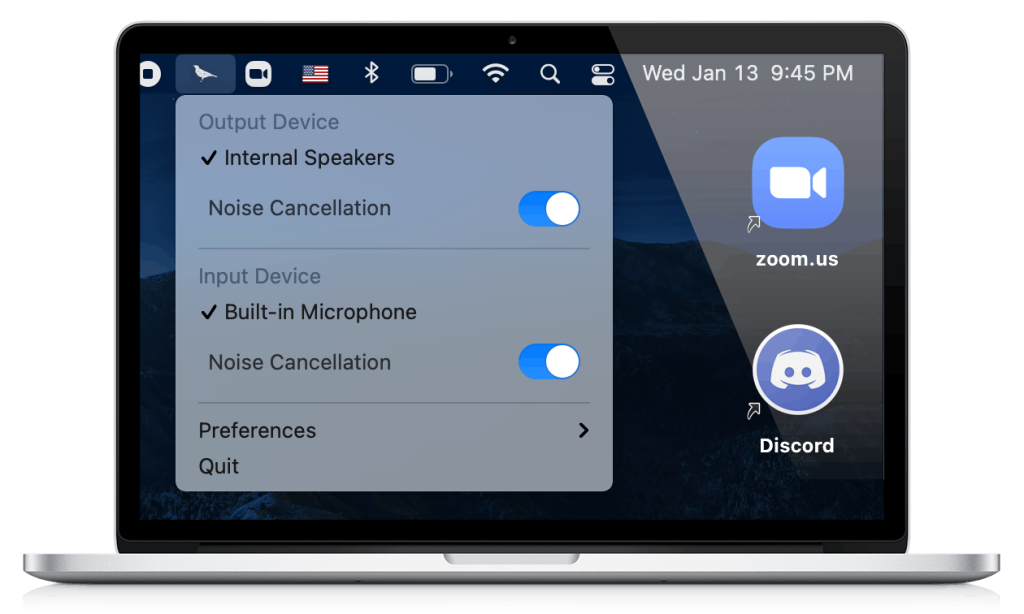
Utterly is a real-time, on-device noise-cancelling plugin for Mac that keeps all processing local, so no audio ever leaves your computer. It focuses purely on audio hygiene, using AI filtering to cut background noise and constant static like fans or AC during Zoom, Teams, Meet, Discord, and other calls. It is battery efficient for long business meetings, live streams, and webinars, and plays nicely with all major conferencing platforms. If you want clean, private audio without bots, cloud processing, or extra steps, Utterly delivers a simple, reliable experience.
However, Utterly is Mac-only and does not support Windows, and its feature velocity feels slower than VC-backed competitors like Krisp. It is an audio-only solution, so you will not get transcription, summaries, or assistant features. Choose Utterly if your priority is rock-solid, privacy-first noise cancellation with minimal overhead and you are fully in the Apple ecosystem.
3. Jamie
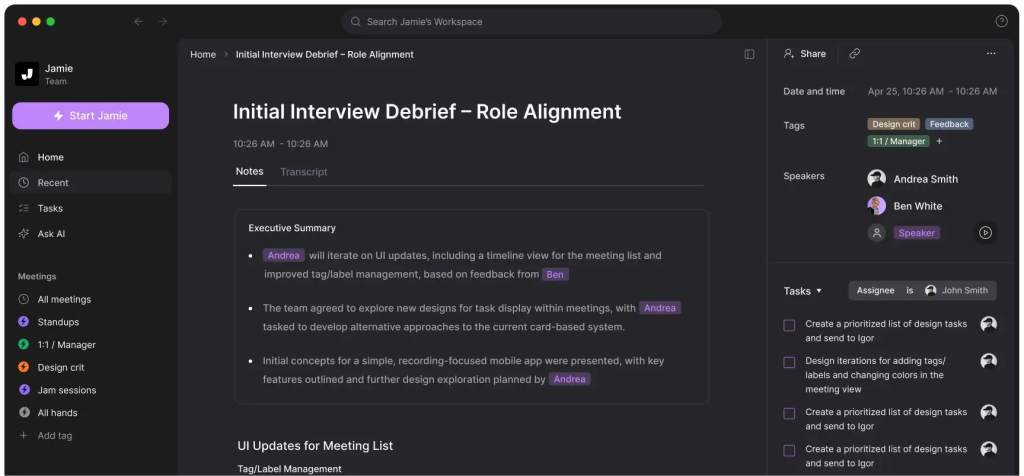
Jamie is a privacy-first, bot-free meeting assistant that runs on your device to capture and summarize conversations in multiple languages across Zoom, Teams, Meet, and even in-person sessions. Unlike Krisp, which leads with audio hygiene, Jamie focuses on fast, accurate transcription and concise summaries that surface clear action items. It works offline, offers customizable summaries, and leans into strict GDPR compliance with secure European hosting.
Tradeoffs are straightforward: Jamie prioritizes simplicity and multilingual accuracy over deep enterprise hooks. You will find lighter native CRM or ticketing integrations and fewer analytics compared to sales-focused tools. But if your 2026 checklist is multilingual coverage, clean on-device capture, and instant takeaways that do not interrupt the call, Jamie is a credible Krisp alternative that replaces noise-first value with summary-first outcomes.
4. Bluedot
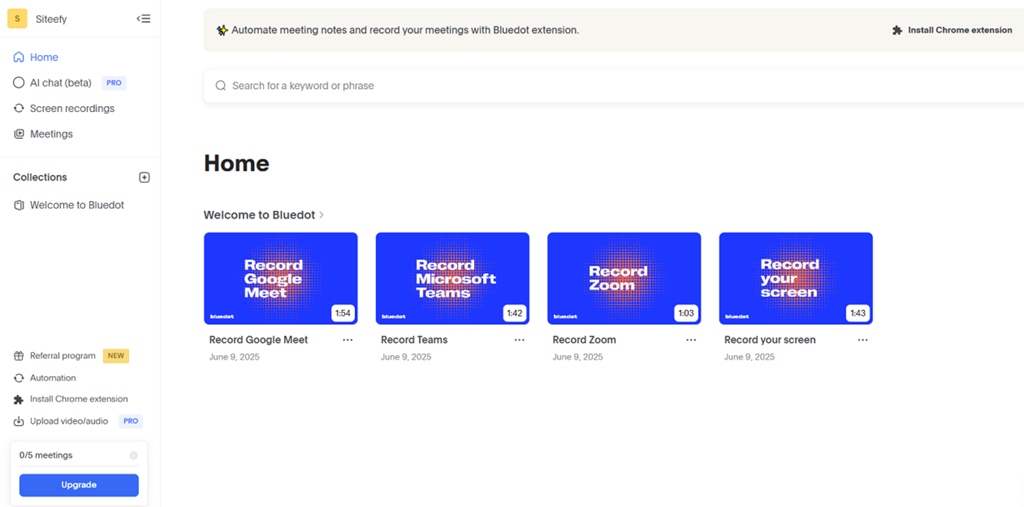
Bluedot is another bot-free, Chrome extension-based meeting assistant. It records in the background and delivers fast, accurate transcription, notes, and analytics without adding a visible participant. Positioned as a Krisp alternative, it goes beyond audio hygiene to automate sales and client workflows: real-time transcription in 100+ languages with high accuracy for technical terms, AI chat to query the conversation and generate instant follow-ups, automated email drafting, and search across all transcripts and notes for quick reference.
It also supports annotation, comments, shareable video highlights, and even video editing by transcript, so teams can turn raw calls into clear takeaways and outreach with minimal friction. If you value a privacy-forward, invisible recorder that converts meetings into actionable notes and follow-ups without bot overhead, Bluedot is a credible Krisp alternative.
5. Tactiq
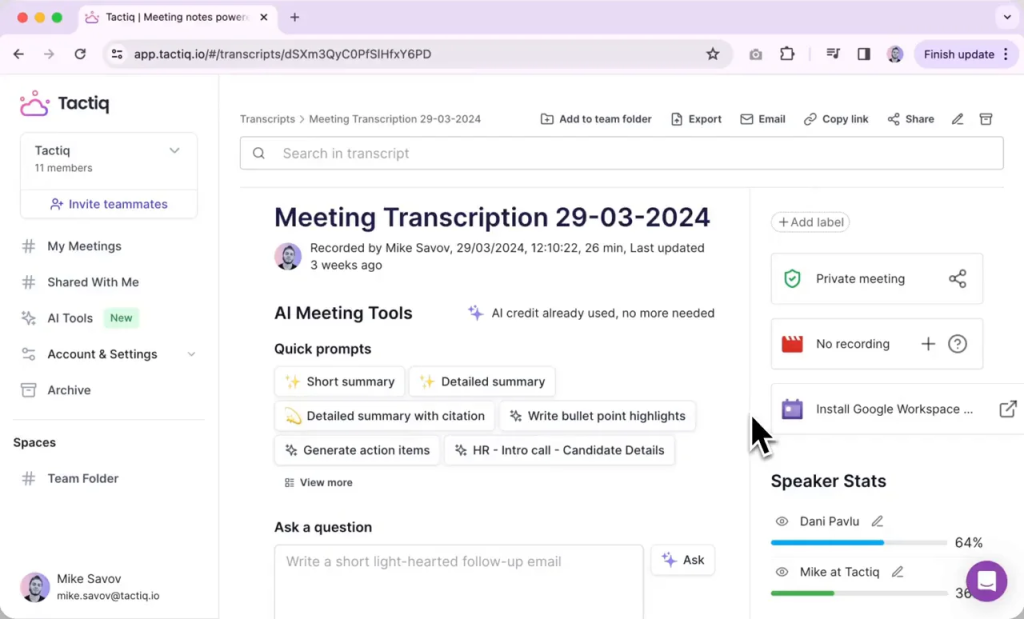
Tactiq is a practical Krisp alternative if you want real-time transcription that turns into work, not just cleaner audio. It runs via a Chrome extension across Google Meet, Microsoft Teams, and Zoom to capture accurate transcripts with speaker IDs, timestamps, and highlights, then generates summaries, agendas, and action items that sync to your stack. You can ask the AI questions about what was discussed, create professional emails from the discussion, and even upload past transcripts or audio for retroactive summaries.
For multilingual teams, Tactiq covers 60+ languages, supports regional dialects, offers a localized UI in 7 languages, and auto-removes filler words so notes read clean. It also picks up emotional tone, which helps reps gauge calls, and can auto-assign tasks to streamline follow-through. It does not aim to be a full sales coaching suite, so teams needing deep coaching or deal analytics may outgrow it. But if your requirement is fast capture, multilingual coverage, meeting-to-task automation, and frictionless adoption, Tactiq delivers a smooth, bot-free workflow that makes every call actionable.
6. Granola
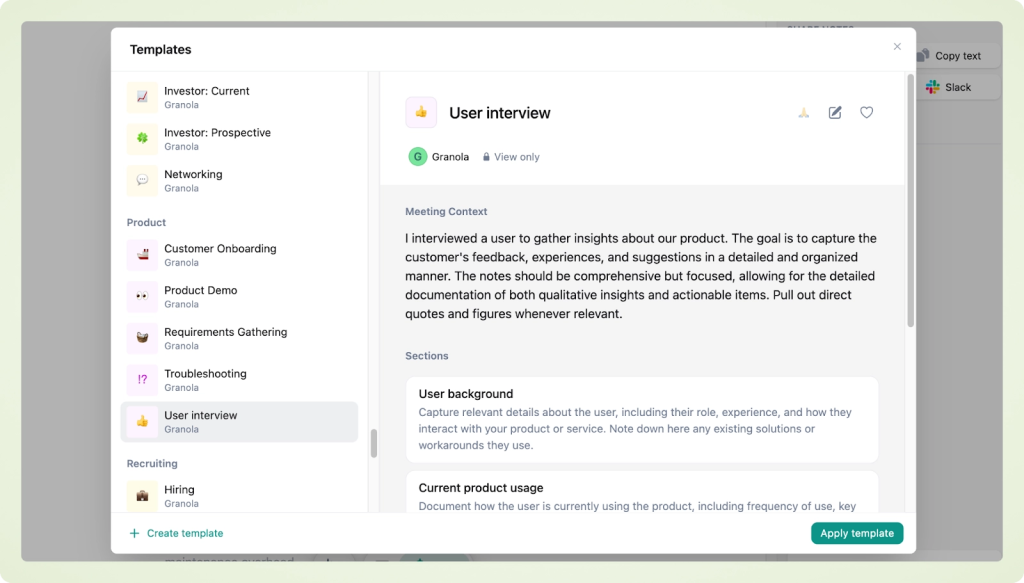
Granola is a lightweight, on-device notepad-style assistant that captures system audio locally and turns it into polished notes, action items, and reusable templates. Positioned as a Krisp alternative, it skips the audio-hygiene-first angle and zeroes in on fast, clear summaries for people in back-to-back meetings. Users like the clean UX and speed. Granola says it does not store raw audio and focuses on transcripts and notes, which is privacy-friendly for many individuals, but it can make it harder to revisit slides or visuals later. Speaker identification may be limited without participant metadata, so it shines when the goal is personal clarity over perfect diarization.
It offers custom templates, intelligent note enhancement, post-meeting task assistance like follow-up drafts and action extraction, and a chat interface to query past conversations. If you want quick, structured summaries and minimal overhead for solo work or freelancing, Granola is a credible Krisp alternative that trades deep integrations and coaching for speed, simplicity, and a familiar notepad experience.
7. Otter
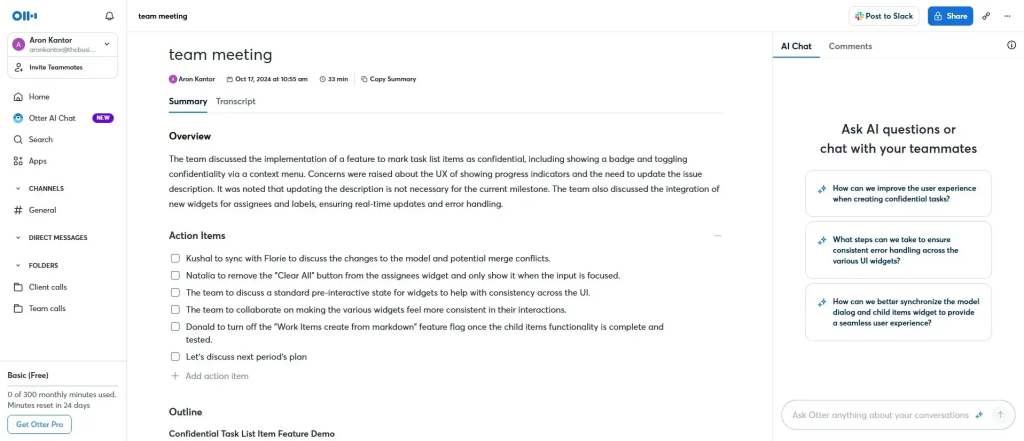
Otter remains a leading transcription-first assistant and a credible Krisp alternative when your priority is real-time captions, searchable notes, and team collaboration. Otter emphasizes live transcription across meetings and interviews, multi-user access on one account, and instant collaboration with comments, highlights, task assignments, and chat. It supports live captions for accessibility, integrates with major meeting platforms, and offers a mobile app for on-the-go review.
Otter excels at capturing and structuring dialogue with meeting summaries, action item management, and fast keyword search, but video recordings are not included in most plans. Despite strong capabilities, accuracy can still dip with certain accents, and teams looking for audio enhancement will find it less focused on noise removal than Krisp. If you need real-time transcription, accessible captions, and collaborative note-taking that multiple teammates can use simultaneously, Otter is a practical, widely adopted alternative.
8. Read.ai
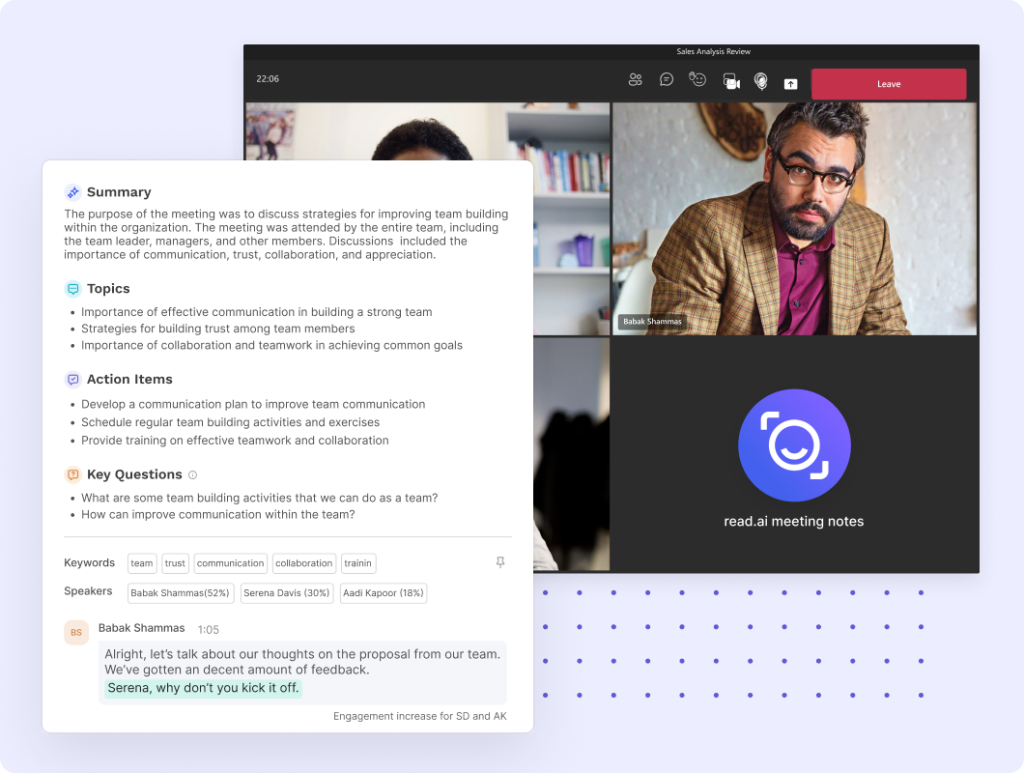
Read.ai is built for teams that want more than clean audio. It records Zoom, Teams, and Google Meet, then layers real-time summaries, engagement metrics, and sentiment tracking on top so leaders can see how the room is reacting while the meeting is still in progress. The Speaker Coach analyzes talk time and speaking style to deliver actionable coaching, and Transcription 2.0 adds audience reactions and clearer, AI-structured notes. Playback with AI-marked highlights makes review fast, and in-meeting widgets surface scores and summaries inside Zoom and Teams rather than burying insights in a post-call report.
Search Copilot lets you query across meeting transcripts, Slack, Teams, Gmail, and Outlook to pull cross-platform summaries and answers on demand. If your 2026 priority is live feedback, coaching, and searchable knowledge that spans calls and communications, Read.ai is a credible Krisp alternative that turns meetings into measurable, improvable interactions.
9. Supernormal
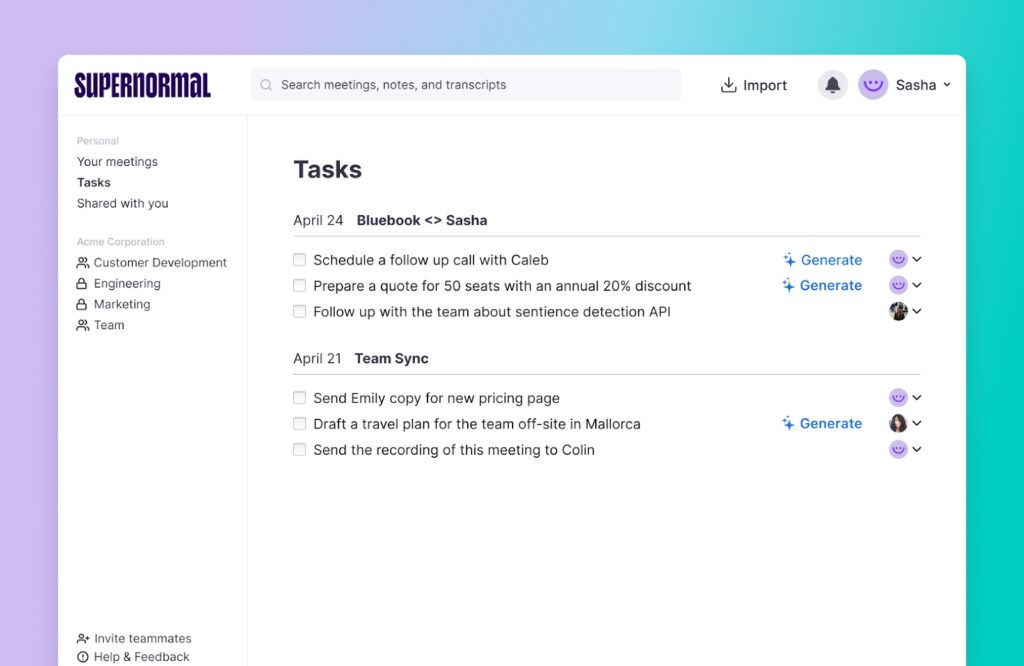
Supernormal is a strong Krisp alternative if you want high-quality AI notes and task handoff without a visible bot. It records, transcribes, and summarizes meetings across Zoom, Google Meet, and Microsoft Teams, then centralizes notes so teams can review and share outcomes quickly. Templates help match different meeting types like 1:1s, client calls, interviews, or team syncs, and Ask Norma lets you query past meetings to pull insights or generate follow ups.
Supernormal prioritizes fast, accurate summaries, action item management, and easy distribution. It captures without adding a meeting bot via extensions or integrations, supports Mac and Windows, and integrates with CRMs like HubSpot to pass key insights downstream. If your 2026 priority is clean notes, repeatable templates, and automated follow-through rather than pure noise suppression, Supernormal is a practical, bot-free alternative that keeps meetings moving and teams aligned.
Conclusion
In 2026, the best Krisp alternatives turn every meeting into client-safe recaps, internal risk flags, and automated follow ups that land in your CRM, PM, and messaging tools without manual glue work. Bot-free capture, smart partition of internal vs external notes, and measurable impact on time to first action and churn risk are the new baseline.
Pick based on your job to be done. If you only need audio hygiene, pick Utterly. If you need transcripts and fast summaries, tools like Otter, Tactiq, Jamie, Granola, Supernormal, Bluedot, and Read.ai cover speed, multilingual support, and coaching in different flavors. If you run client-facing teams and care about scope creep detection, branded client recaps, and tasks that actually move, FuseBase is the upgrade path from recorder to delivery platform. Whatever you choose, demand proof: faster follow-ups, fewer missed commitments, clearer client alignment, and account risks caught earlier. That is how you outgrow a mic filter and turn meetings into revenue.